Earlier Than you Think: SAP Security Activities Worth Pulling Forward
In our previous piece, we argued that SAP security can no longer be an afterthought in migration programmes. Under the FUE licensing model, the cost of a sub-optimal role design begins on day one of go-live, not at some future license audit.
Knowing security needs earlier attention is easy; knowing what to do about it is harder. Project capacity is finite, timelines are real, and the obvious answer – redesign your SAP roles before you migrate – is not always right.
So what is? It depends on your situation. But there is more you can pull forward than most organisations realise, and some of it holds value regardless of whether a pre-migration redesign makes sense for you.


Start with the Role Redesign Question – and Answer it Honestly
For some organisations, redesigning SAP roles in ECC before migrating to SAP Cloud ERP Private is the right call. For others, it is not. The honest answer depends on a few variables.
A brownfield migration, where processes, job functions, and system architecture carry significant continuity from ECC, makes the strongest case for a pre-migration redesign: you are building on something that will still exist afterward, so the work will not be wasted.
A greenfield implementation is different. If processes are changing materially or job functions are being restructured, a design built around current processes may not map cleanly to what you need post-migration. It often makes more sense to design roles during the migration project itself, with licensing built in from the outset.
Fiori is the other major variable. Fiori apps rely on additional authorisations — catalogues, pages, spaces and OData service authorisations — that do not exist in an ECC role design. The more Fiori apps you introduce, the more rework any role will need, regardless of when the redesign happened. A Fiori-ready methodology reduces that rework; it cannot eliminate it.
If the case for pre-migration redesign is strong for you, do it. If not, that is not a reason to defer all security preparation – it is a reason to focus on what else can be pulled forward.
What Else can be Done Earlier
Role redesign is the highest-profile security activity in a migration, but not the only one. The activities below deliver real value when completed early, and most can progress independently of role redesign timing.
Establish your governance framework before go-live
The most common post-migration problem is not technical. Many organisations have compliance processes built to satisfy audit, without genuine ownership of access risk: no named owner, no clear decision rights, no accountability structure.
FUE changes that equation. Who owns the FUE position? Who can approve access changes that affect consumption? Who is accountable when the monthly meter reads higher than expected? These questions do not resolve themselves at go-live. Defining ownership, decision rights, and escalation paths before migration means you arrive with a structure already in place. For many organisations, FUE cost is the catalyst that finally drives real access-risk governance into place.
Complete your policies and procedures documentation
Many organisations carry outdated policies into migration. FUE cost is a useful driver to update and genuinely enforce access-risk policies, not just document them for audit. An FUE owner, for instance, adds a layer of review to access requests that did not exist under the named-user model.
Documented policies are the foundation for everything else – role design, access requests, review cycles, license management. Completing this while still on ECC produces better output and removes a workstream from the post-go-live backlog.
Customise your access risk rule set
Most relevant to brownfield migrations, where process continuity lets the existing rule set be meaningfully refined before go-live. Most organisations run a standard, out-of-the-box rule set. This is a missed opportunity.
Vendor rule sets cover a broad range of operations; many flagged risks won’t apply to you, but will still generate findings that create noise and obscure what matters. Customising the rule set to your processes and risk appetite produces a cleaner, more actionable picture, calibrated to your environment rather than needing post-go-live remediation. New Fiori access should have a natural home within existing rule set functions.
Train your compliance officers and business stakeholders
Updated policies only deliver value if the people executing them understand what changed and why. A governance framework on paper alone achieves nothing.
FUE means familiar processes carry new considerations: access requests need an FUE assessment alongside the usual review, and user access reviews must weigh not just whether a role is appropriate but whether it is FUE-efficient. Training this audience before go-live means your governance framework is run by people who understand why it matters.
Set up FUE consumption monitoring before you need it
FUE consumption is visible from day one. Organisations with a monitoring process in place from the start — defined owners, review cadence, escalation triggers — are in a fundamentally different position than those seeing consumption data for the first time months later. Setting this up before migration, even if it cannot be fully tested until go-live, closes a critical gap in readiness.

The Goal is to Arrive with a Plan
The worst outcome is not a sub-optimal role design at go-live. It is arriving with an unexamined role design, no usage data, no governance framework, no trained stakeholders, and no monitoring process — where unnecessary FUE exposure compounds and the grace period SAP has provided gets absorbed with nothing to show for it.
Not every activity here will be the right priority for your organisation, but which ones apply to you deserves a deliberate answer, worked through with your SAP security resource before your migration programme moves into delivery.
Security preparation does not have to mean role redesign. It does mean intention — and intention is something every organisation can afford to have early.
Not Sure Where to Start?
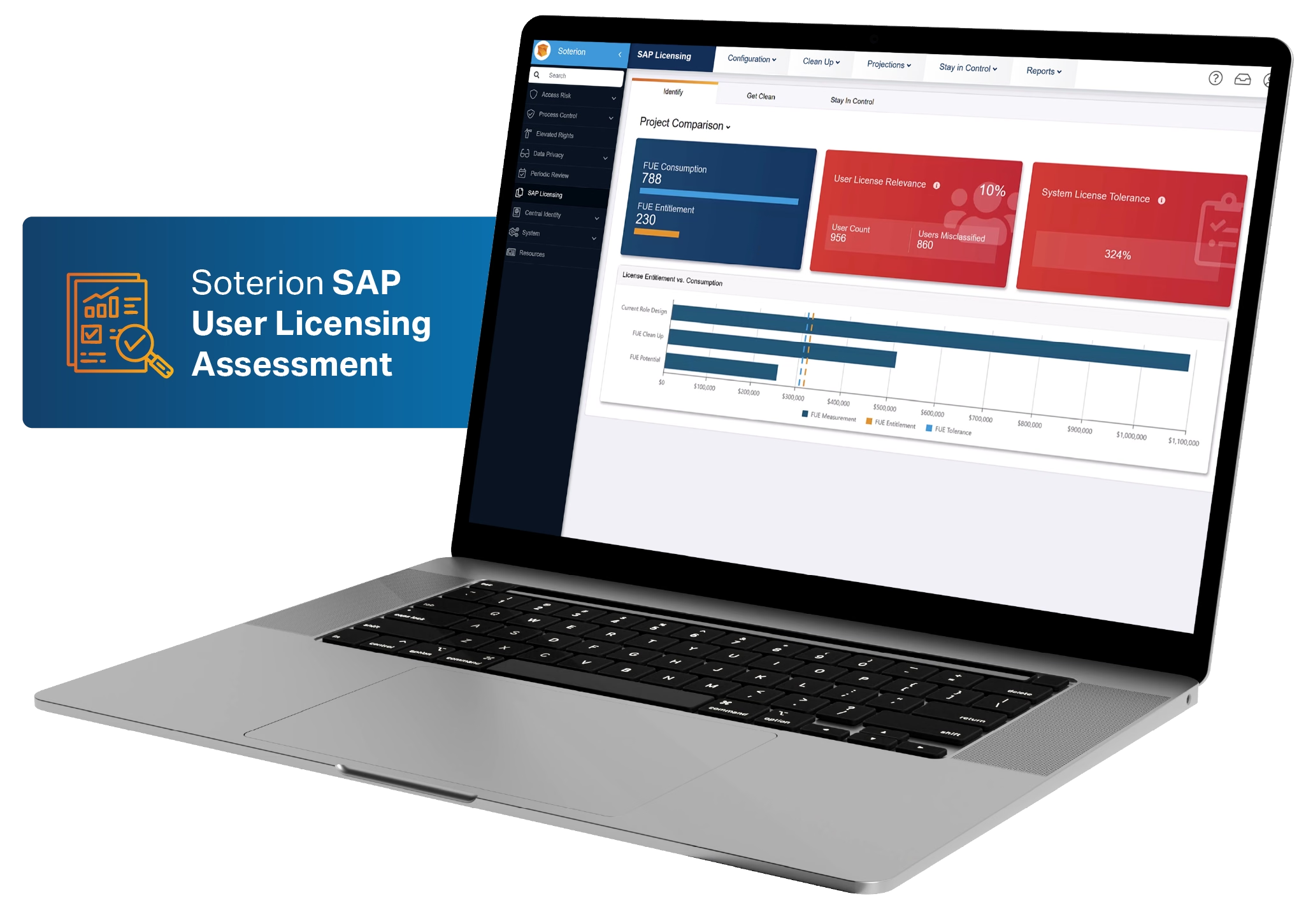
Soterion works with organisations at every stage of their SAP Cloud ERP Private journey, from pre-migration planning and FUE baseline assessment through to post-go-live optimisation. Get in touch with the Soterion team by emailing [email protected] to discuss which security activities make sense for your situation and timeline.